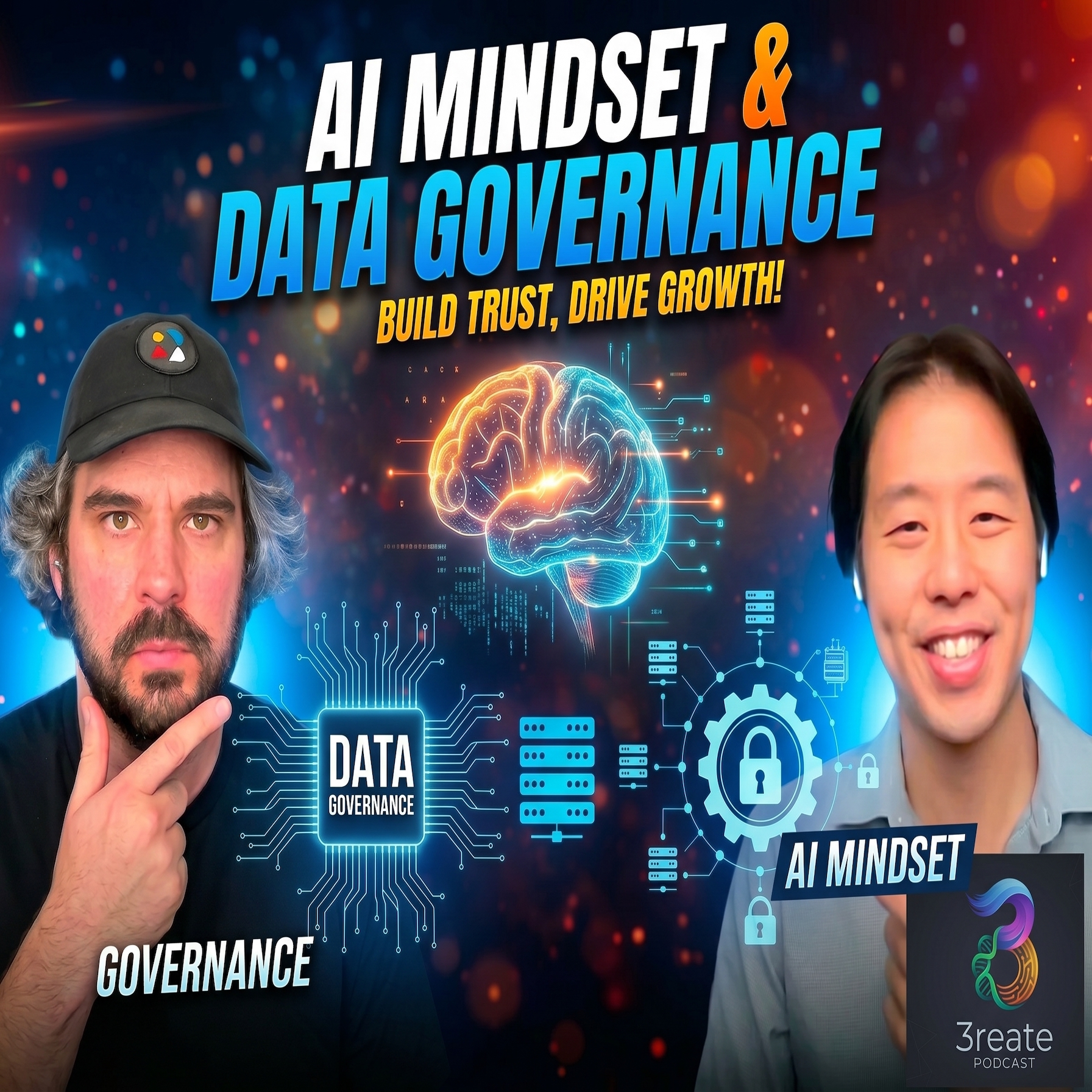
We tackle the elephant in the room: Data Governance. Andrew and Nathan sit down to unpack the real “AI Mindset” necessary for the modern creator, developer, and executive. We move beyond the hype of flawless AI automation and dig into the messy reality of the software development lifecycle. From fixing memory management crashes caused by AI-written code to understanding why an LLM needs you to hold its hand through every context shift, we explore what it actually takes to build reliable tools alongside artificial intelligence.
Is your proprietary data actually as sacred as you think it is? We deconstruct the hoarding mentality that paralyzes companies and offer actionable frameworks for exposing your data models securely. Whether it’s safely utilizing foundational models or bridging the friction between gatekeeping IT departments and eager product managers, this episode provides the blueprint for scaling AI responsibly.
AI Data Governance
Executive Summary: AI Data Governance is currently misunderstood as a strictly technical challenge when it is primarily a cultural and management problem. Organizations artificially throttle their own AI potential by treating all internal data as sacred, highly proprietary, and untouchable. True AI governance requires taking a realistic inventory of your data’s actual value, dismantling internal IT gatekeeping, and finding secure ways to empower non-technical teams. By exposing data schemas rather than raw PII and fostering an environment of psychological safety, companies can securely leverage foundational models to multiply their workforce’s productivity.
Key Points:
- Reevaluate Data Sanctity: Companies default to hoarding data, but executives must ask hard questions: Is this data actually unique? What happens if it leaks? Do we even need to be collecting this PII in the first place?
- Expose Schemas, Protect Raw Data: You don’t always need to feed sensitive data into an LLM to get value. Empower employees by exposing the data model or schema to the AI, allowing it to write queries and build reports without ever touching the underlying raw data.
- The “Build vs. Buy” Trust Factor: If you already trust third-party enterprise vendors with your cloud hosting or IT security, you can likely trust foundational AI model providers by implementing proper enterprise agreements and boundaries.
- Governance is a Management Issue: Employees hoard data and block AI integration when they lack psychological safety. If your culture punishes people for making mistakes or breaking things during experimentation, they will refuse to adopt the AI tools necessary to scale the business.
The AI Mindset
Executive Summary: The “AI Mindset” requires a fundamental shift away from expecting perfection or “magic” from generative AI. Because generative AI is inherently non-deterministic, it will inevitably hallucinate or introduce bugs—much like traditional software development. To succeed with AI, creators and engineers must treat the technology like a highly capable but completely uncontextualized collaborator. This means embracing an iterative loop of prompting, applying critical thinking to manage edge cases, and focusing on the massive productivity gains of “what could go right” rather than being paralyzed by what could go wrong.
Key Points:
- Embrace Non-Deterministic Outputs: Generative AI is not a deterministic calculator; it operates on statistics. If you spend all your time trying to force it into rigid deterministic filters, you defeat the purpose of using it.
- The Context Deficit: Unlike humans who carry vast amounts of implied cultural and institutional knowledge, AI only knows exactly what you tell it in its current context window. You must explicitly set the stage, outline contraindications (what not to do), and explain the “why.”
- Master the Iterative Loop: Building with AI requires a constant cycle of zooming in and zooming out. You must focus the AI on a narrow, specific problem (like a login screen), and then zoom out to critically think about how that fix impacts the broader system.
- Critical Thinking is the Ultimate Skill: AI cannot self-prompt effectively. It requires a human in the loop who can anticipate edge cases, ask hard questions, and steer the creative or developmental process.
Watch on YouTube: https://www.youtube.com/live/IEb1_aAHo9I
Time Stamps:
(00:00:00) Pre-show banter and minor technical difficulties
(00:01:45) Why Gen AI fails customer-facing products
(00:05:30) Transitioning AI proof of concepts into production
(00:10:00) Debugging AI code and unexpected edge cases
(00:15:45) Giving up the expectation of AI perfection
(00:17:40) Focusing on what can go right instead
(00:22:00) Understanding why AI lacks human implicit context
(00:24:45) Mastering the iterative loop of AI prompting
(00:36:05) Reevaluating the true value of internal data
(00:41:30) How to expose data models to AI safely
(00:45:40) Why data governance is a management problem
(00:51:00) Using AI tools to multiply worker productivity
(00:55:45) Wrapping up with fun May Day triviaAI Mindset and AI Data Governance?
Support the pod:
https://3reate.com
https://ko-fi.com/3reate
https://patreon.com/3reate
Listen:
https://podcasts.apple.com/us/podcast/3reate/id1723426314 https://open.spotify.com/show/48Y2M7Ppja43Uq2wlyUtPF https://www.youtube.com/@3reate