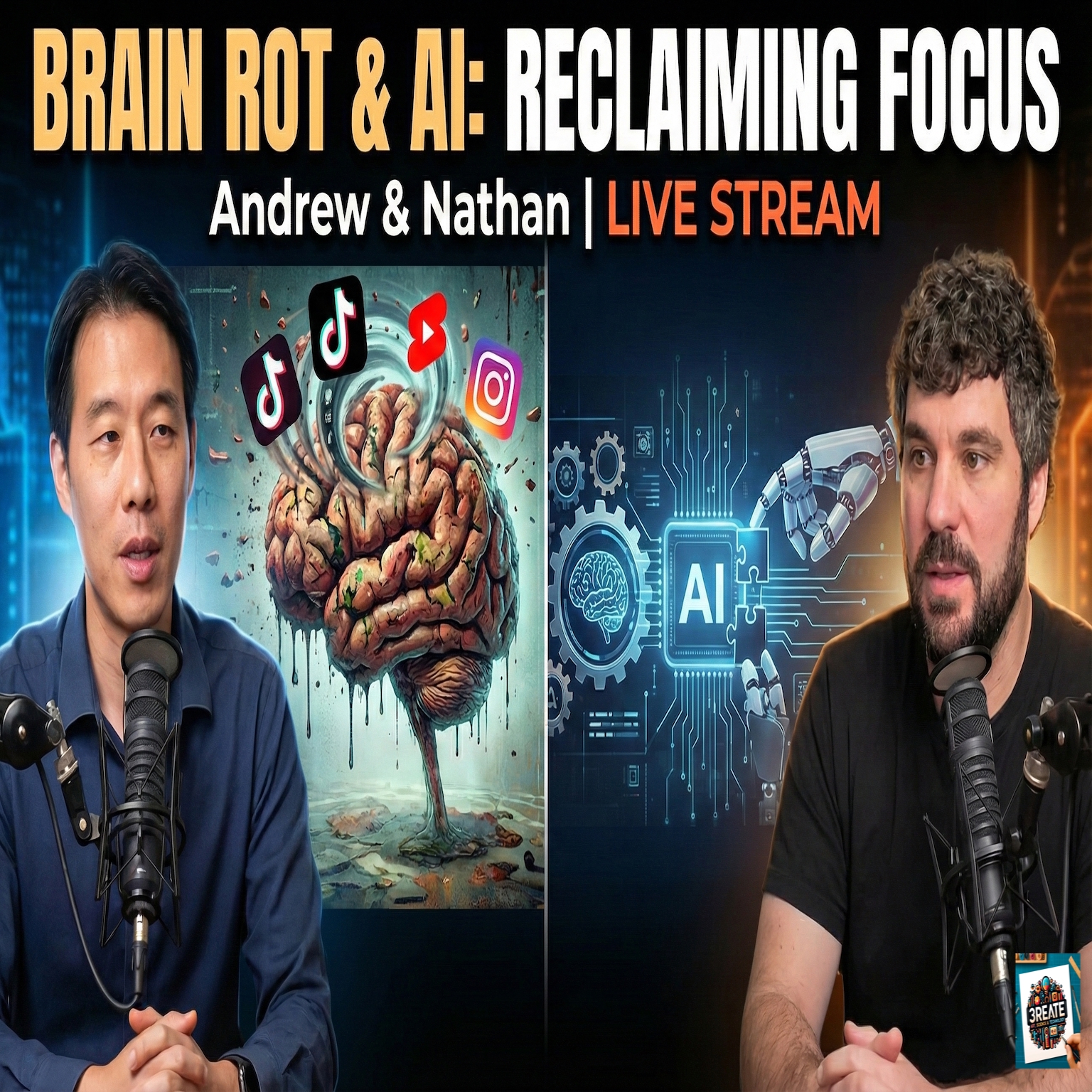
Andrew and Nathan dive into the concept of “Brain Rot” and whether short-form content is destroying our ability to focus. They discuss the difference between consuming information and gaining true wisdom, warning against the illusion of competence. Later, the conversation pivots to Artificial Intelligence, exploring how “context engineering” with LLMs can actually train us to be better human collaborators by prioritizing clarity over politeness.
Is “Brain Rot” a real medical condition or just a slang term for a generation losing its attention span? In this live-streamed episode, Andrew and Nathan break down a recent NBC News article warning of the emerging risks tied to short-form video.
They explore the terrifying impact of the scroll-loop on critical thinking, the loss of nuance in societal debates, and the false confidence created by 30-second tutorials that mimic mastery. But it’s not all doom and gloom. The hosts discuss actionable strategies to reclaim your focus, including the importance of “slow” hobbies like cooking, puzzles, and crochet that force delayed gratification and deep work.
The conversation then takes a technical turn toward Artificial Intelligence. Andrew argues that working with AI has made him a better collaborator. They discuss the art of “Context Engineering”—moving beyond simple prompt engineering to provide deep background—and how the frustration of communicating with an LLM mirrors the challenges of delegating tasks to real people.
Finally, they wrap up with a philosophical look at why AI models (and modern workplaces) suffer from being too “nice” rather than being “kind,” and why honest feedback is the ultimate form of collaboration.
Watch us on YouTube: https://www.youtube.com/live/P6ArSg96gCE
Support the pod:
Listen:
https://podcasts.apple.com/us/podcast/3reate/id1723426314 https://open.spotify.com/show/48Y2M7Ppja43Uq2wlyUtPF
Chapters:
(00:00) Hello!
(01:52) Discussing NBC article on brain rot risks.
(05:10) Redefining brain rot as attention rot.
(08:40) Short-form content versus distinct mastery skills.
(10:06) Dunning-Kruger effect and startup founder ignorance.
(16:40) Rebuilding focus through slow, deliberate hobbies.
(21:20) Using AI to improve human collaboration.
(23:30) Importance of context engineering in prompting.
(30:30) Distinguishing between being nice and kind.