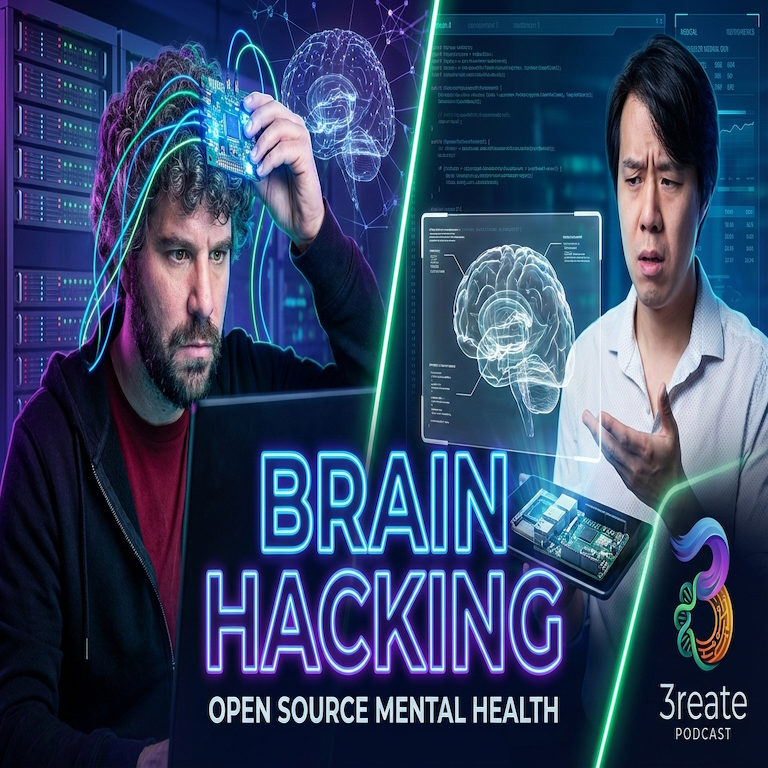
In a world of AI noise, real-world innovation often gets buried under proprietary paywalls. Today we’re debuting our new “Edge Collider” format—a collaborative, workshop-style deep dive designed for the applied polymath. Instead of a passive interview, we’re putting a real-world prototype on the table. Today’s subject: Open Source tDCS (Transcranial Direct Current Stimulation).
Neurological conditions like depression and anxiety remain notoriously difficult to treat, often requiring expensive or invasive clinical intervention. By open-sourcing the hardware and software protocols for tDCS, we are working to lower the barrier to entry and facilitate a “standardization of protocols” that the current scientific field lacks.
In this episode, we break down:
- The “Edge Collider” Philosophy: Why we’re replacing “show and tell” with collaborative, high-stakes peer review.
- The Hardware Reality: The raw truth about building physical products, managing supply chains, and the “human labor” required to facilitate clinical science.
- The Open Source Paradox: Why we chose a specific license to force collaboration rather than letting our research sit stagnant in a private repository.
- Safety & Ethics: How we’re using firmware constraints to ensure this technology remains a tool for wellness, not a hazard.
We don’t just want you to listen—we want you to build. You can find the full schematics, bill of materials, and firmware in the links below.
Watch: https://www.youtube.com/live/z1ZmxE8DnhE
Time Stamps:
(00:00) Intro: The “Edge Collider” format
(05:48) The Science of Open Source tDCS
(08:42) Motivation: Why build neurological tech?
(11:35) Scaling: The challenge of physical products
(13:39) The hardest part of the build
(17:48) Licensing: Why GPL vs. BSD matters
Support the pod:
Listen:
https://podcasts.apple.com/us/podcast/3reate/id1723426314 https://open.spotify.com/show/48Y2M7Ppja43Uq2wlyUtPF https://youtu.be/2wEMD8EvB9I?si=G3iUBE-z4Mx0Ng-Y